Geert Van Lierde has been writing about Belgian beer for years, and his website holds hundreds of articles. These days, though, people ask a general AI chatbot, and it confidently tells them things about beer that are flat-out wrong. So we built him his own chatbot, one that only knows what Geert knows.
Geert Van Lierde is a beer journalist and author. His website is an archive of years of writing about Belgian beer and beer culture: beer styles, breweries, tasting, and pairing beer with food.
What he had was solid. The trouble was how people look things up now. Someone who wants to know about Trappist beer or a particular beer style types the question into a chatbot. When Geert tried that himself, he got answers that were way off. They read well, they sounded sure of themselves, and they were wrong.
For someone who built a career on getting it right, that's a big deal. Accuracy is what sets him apart.
What if people could ask their question the way they're used to, and the answer came from his work? They'd get a short answer and a link to the full article. His pieces would get found again, and he'd stay the source.
A project like this doesn't need an audit. It needs a good conversation about what the bot is allowed to do and, more importantly, what it isn't.
A custom chatbot is only as good as its limits. Hopbot's are strict:
Geert's material comes first. The bot checks his documents and standard answers first, then his own web pages, and only after that does it look further.
It never makes up a link. If the article doesn't exist, there's no link.
It stays in his lane. Belgian beer, beer culture, tasting, brewing and food. For anything else, it politely says that's outside its field.
If it doesn't know, it says so. Then it points you to Geert. The first testers said that was the most human thing about the bot.
It doesn't write articles. That's Geert's job.
Then you have something the general models don't: your own knowledge. A custom chatbot turns that into an edge.
It's a chatbot on his website with its own name and its own face:
His articles, his documents, and a set of standard answers to the questions that come up most.
His documents first, then his web pages, and only then anything else. Every answer stays his.
The bot summarizes and sends people on. Anyone who wants more reads the full piece on the site.
Hopbot has a face, in a few versions: classic, in the kitchen, and a festive one for the holidays.
Where the bot stops, Geert takes over, and his email address is right there.
New articles, new answers, a stricter or looser tone. It keeps growing with his work.
This is an AI agent at its simplest: one job, strict rules, nothing extra.
It searches, picks its source in a fixed order, gives a short answer and sends people on, all inside the limits Geert set.
It doesn't guess. It sends you to Geert.
We had fellow journalists test the bot first. They know the field, so they spotted right away where it went wrong. Their notes became the rules above.
We did a round of tuning in January, and since then we've adjusted it whenever something new comes in.
First-month numbers: 250 conversations with 161 unique visitors. People asked about beer styles, Trappist beer, how beer is made, and which beer goes with which dish. Here's what matters more:
Things quieted down after the first month, as they do once the novelty wears off. That's what we're working on now: a dedicated page for the bot, a more noticeable button, and some attention on his social channels. Building a good chatbot is the first job. Getting people to find it is the second.
On your website, with your rules and your tone. We start with the content you already have.
The next steps are mostly about visibility: giving Hopbot a permanent spot on the site and showing it in action. The content side grows on its own, since every new article adds to what it knows.
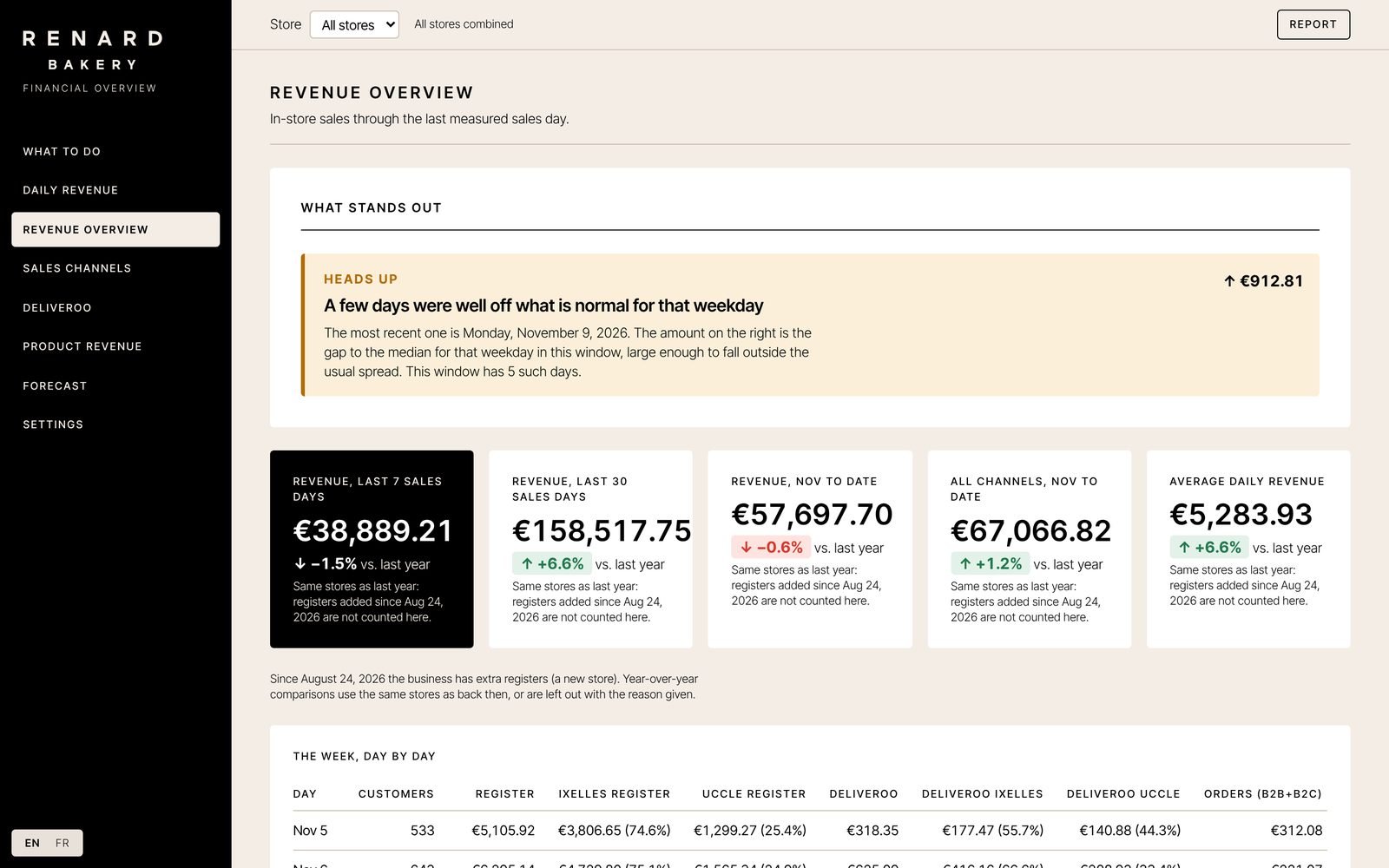
Renard Bakery went from a one-day audit to its own numbers platform, which management opens every day. Includes screenshots of the real platform.
Read the Renard Bakery case study →
Most projects start the same way, and it doesn't take months to get going:
You tell me what you do and where you're stuck. I'll tell you straight whether an audit makes sense or whether something smaller would do the job.
I come to where the work happens and watch. How does work come in? Who decides what? Where does the time go? Which tools are you already paying for?
Within a week you get a report: where time and money are leaking, your priorities in order, a review of your tools, and concrete proposals in more than one size.
Do all of it, part of it, or none of it. If you move ahead with a build, the audit fee is credited in full.
Your team tests as we go. Nothing ships until the people who'll use it have tried it.
If you want it to keep running and keep growing, we look after it on a fixed monthly retainer.
An AI audit costs $2,000, credited in full if you move ahead with a build.
Book your audit day →It starts with a conversation. You tell me where you're stuck, and I'll tell you what I'd do and what it would cost.